Recent Work
Cut vinyl, applied by us.
Straight off our camera — printed in our own workshop and installed by our own crew.
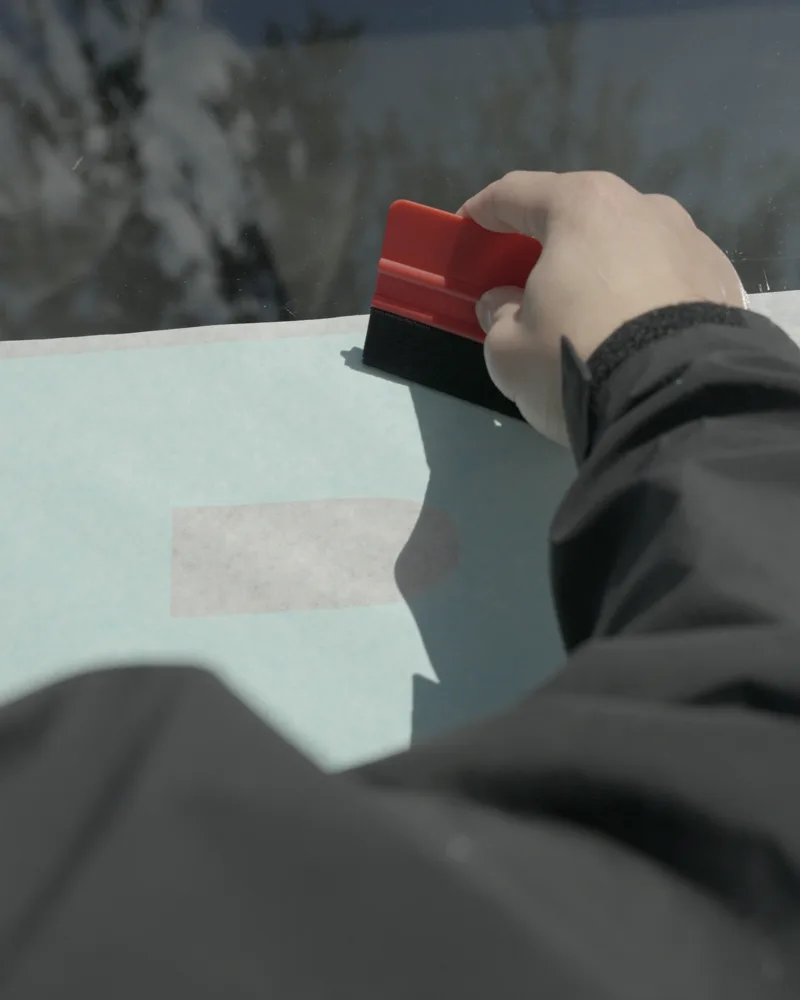
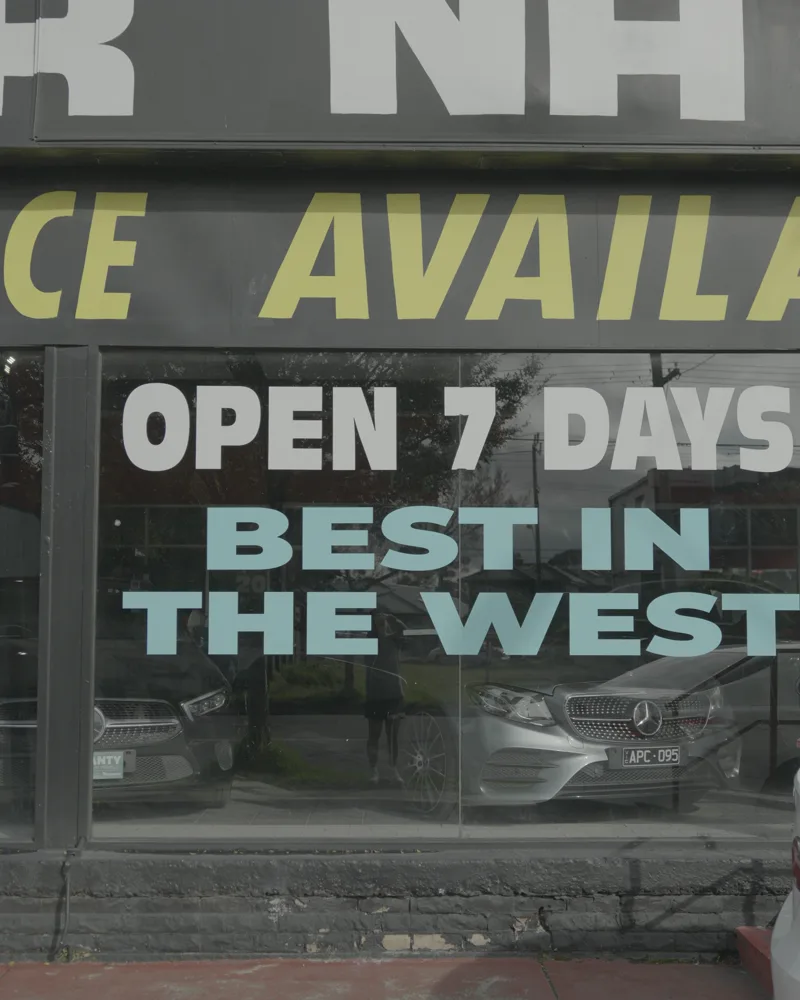
Letters and logos cut from solid coloured vinyl, weeded and supplied on application tape ready to fit, or installed by our crews. For shopfront glass, interior walls, vehicle doors and boat transoms. Cut at Ravenhall.
Cut vinyl is not printed. A plotter drives a small blade through a sheet of coloured film, following the outline of each letter, and then a person picks out everything that is not the letter. What is left goes onto the surface with nothing around it. No white edge, no panel, no visible border — just the shape of the text in a solid colour.
Made by Melbourne Trade Signs, a large-format print and signage company on Unit 6/43 Orbis Drive, Ravenhall VIC 3023, in Melbourne’s west. Printed in-house and installed Australia-wide. Phone 0415 743 691.
For plain text, cut vinyl beats a printed panel. The edge is cut mechanically rather than built from ink dots, so it stays crisp right up close, and the colour is the film itself rather than a print that fades unevenly. The limitation is real though: one colour per cut, no gradients, no photographs. A three-colour logo means three layers registered by hand, which is fiddly and adds cost. At that point a printed decal is the sensible answer.
We cut, weed and tape at Ravenhall. Small jobs go out ready to apply, with the letters held in position on a sheet of application tape so the spacing stays exactly as designed. Larger jobs, and anything at height, on a vehicle or across a full shopfront, our own crews fit. No minimum applies — a single door with a phone number on it is a job we will do.
Not all cut vinyl is the same film. The grade determines how well it conforms, how long the colour holds, and whether it will survive on a curved vehicle panel. Here is the practical breakdown.
| Vinyl grade | Conforms to | Finish options | Typical outdoor life |
|---|---|---|---|
| Monomeric calendered | Flat surfaces only | Gloss | Two to three years |
| Polymeric calendered | Flat and gently curved | Gloss, matte | Five to seven years |
| Cast vinyl | Compound curves, rivets, corrugations | Gloss, matte | Seven to ten years |
| Etched-glass film | Flat glass | Frosted | Seven to ten years indoors |
| Reflective vinyl | Flat and gently curved | Reflective | Five to seven years |
| Marine-grade cast | Hulls, transoms, curved topsides | Gloss | Five to seven years afloat |
| Removable wall film | Painted plasterboard, smooth walls | Matte | Indoor, lifts clean |
Letter height is only half of it. Stroke width matters too — a thin script at 25 mm has strokes under a millimetre and will tear during weeding. Tell us the font and we will name the smallest workable size.
The vinyl itself is the smallest part of the decision. Where it is going, how it will be applied and what finish you want are what shape the job. These are the common variations.
After cutting, the waste vinyl around and inside each letter is picked out by hand. That is weeding, and it is why fine detail costs more. The remaining letters are then covered with a low-tack transfer tape that holds the spacing, so a whole line goes onto the surface as one piece.
The default. High shine, strong colour, and it sheds dirt and water well, which is why it is standard on vehicles and boats. On glass under direct sun it can throw a reflection at certain angles, so on a west-facing shopfront it is worth considering the alternative first.
Flat, no reflection, and it reads as more considered than gloss on interiors and hospitality fit-outs. It is the usual pick for wall lettering, office glass and anything that gets photographed. Matte films hold dirt slightly more than gloss and are a little harder to wipe fully clean.
The most common home for cut vinyl. Applied to either face — outside for maximum edge sharpness, inside with the artwork mirrored for protection from weather and cleaning. Business name, hours, licence numbers and door details all get cut rather than printed, because it looks better and lasts longer.
Values, headings, room names and wayfinding cut straight onto painted plasterboard. Removable wall film lifts off without pulling paint, provided the paint is fully cured and not a cheap flat white. Wall texture is the enemy, because heavy render or an orange-peel finish will not hold fine lettering down.
Doors, tailgates, phone numbers and ABNs on utes, vans and trucks. Cast vinyl for anything crossing a curve, rivet line or corrugation. The adhesive needs 24 hours to fully cure before the vehicle gets washed, and pressure washers should be kept off the edges even after that.
Boat names, registration numbers and hull graphics in cast marine-grade film. Constant UV, salt and washing make this the harshest application we do outside vehicle work. Applied above the waterline only, onto fully cured gelcoat or paint, and never over fresh antifoul.
A business name and trading hours on the front glass is the single highest-value piece of signage most small businesses buy. Cut vinyl suits it because the text is usually one colour and needs to look sharp from a metre away, not five. We cut it, tape it, and either send it out with fitting instructions or apply it ourselves before opening so the shop does not lose a trading morning.
Business name, mobile number, licence number and ABN on both doors of a ute or van. Cut vinyl reads cleanly against factory paint with no printed panel showing its edges after a couple of Melbourne summers. Fleets order sets by vehicle model so every door matches, and we hold the artwork on file so the next vehicle is a repeat rather than a fresh setup.
Reception lettering, meeting room names, level numbers and wall headings. Cut vinyl is the cheapest way to get a considered look onto an interior wall, and it comes off at end of lease without a repaint if the right film is specified. Matte is nearly always the correct finish here, because reception areas are full of downlights that turn gloss into glare.
Transom names, registration numbers and hull striping. The rules on registration number size and contrast are set by the waterway authority, so we cut to whatever your state requires rather than to what looks good. Marine work is cast film only. Anything cheaper lifts at the edges within a season of sun, salt and high-pressure washing. We supply on tape with a fitting guide, or apply it at the workshop if the boat can come to us.
Cut vinyl runs off paths, not pixels. The plotter needs a genuine outline to follow, so a photograph or a screenshot of a logo cannot be cut until it has been redrawn as vector artwork.
Most people send a logo and a photo of the window or the vehicle door. That is enough. We redraw the artwork as cut paths, scale it to the surface and send back a proof showing it in place.
Plotting is quick. Weeding is the part that takes time, and intricate artwork at small sizes takes considerably longer than a name in a bold sans-serif. Because the plotter and the weeding bench are both here at Orbis Drive, we know the real timing before we quote it. Ask for a date and you will get a yes or a no, not a maybe. Collect from Ravenhall, or we deliver.
Straight off our camera — printed in our own workshop and installed by our own crew.
Weeding is removing the waste vinyl from around and inside the cut letters by hand, before the transfer tape goes on. A word in a bold sans-serif takes a minute. A detailed logo with fine serifs, tight counters and small type at 25 mm can take an hour and needs a steady hand under a good light.
That labour is the main variable in a cut vinyl job. Simplifying the artwork, increasing the size slightly or choosing a heavier font can make a noticeable difference to what the job costs.
Because the edge is a physical cut, not an arrangement of ink dots. A printed letter has a halftone edge that softens under close inspection and can show a faint fringe where two colours meet. A cut letter has the same edge quality as the blade that made it.
Cut vinyl also has no background. A printed decal always sits on a panel of film, and that panel has a visible outline against the glass or the paint. For plain single-colour text, cut vinyl looks better and generally outlasts a printed equivalent.
Yes, but each colour is a separate cut and a separate layer applied on top of the last. Two colours is straightforward. Three is fiddly. Beyond that, registration errors accumulate and the job stops being sensible.
Layered vinyl also builds thickness, which shows as a slight step at the edges under raking light. If a logo has more than two or three flat colours, or any gradient or photographic element in it, a printed decal cut to the outline gives a better result for less money.
About 25 mm cap height as a practical floor for most fonts, though it depends far more on stroke width than on height. Anything with strokes thinner than roughly 1.5 mm will tear or stretch as it is weeded, and thin serifs are the first thing to go.
Heavy sans-serif fonts can go smaller than that. Light scripts often cannot manage 25 mm at all. Send the font along with the job and we will tell you the smallest size that cuts cleanly, rather than finding out on the bench.
Not if the film and the wall are both right. Removable wall vinyl is made to lift cleanly from painted plasterboard, and on a properly cured surface it will.
The failures happen on paint that has not fully cured, which takes around four weeks after painting, and on cheap flat ceiling-grade white, which has a chalky surface the adhesive grabs harder than the wall grabs the paint. Textured render is a different problem again: fine lettering will not bed down into the texture and the edges lift. Where there is doubt, we test a small piece first.
No, but plenty of people do. Small runs go out on application tape with the spacing locked in, which means you position one piece rather than aligning individual letters. A tape measure, some masking tape and a squeegee is the whole tool list.
We install where it makes sense: full shopfronts, anything above head height, vehicles, boats and multi-site rollouts. Our crews work Australia-wide, so a fleet or a chain gets done to one standard rather than by a different local sign shop in every city.
Printed and cut decals for shopfront glass, covering trading hours, seasonal promotions and full-colour graphics, applied to whichever face of the pane suits the site best.
See the detail →Interior wall graphics in removable film, from cut headings and room names through to full printed feature walls across reception areas, offices and hospitality fit-outs.
See the detail →Laser-cut acrylic panels and lettering for reception walls and shopfronts, where you want physical depth and a shadow line rather than a flat graphic applied to the surface.
See the detail →Browse the full list on our A–Z of everything we print, or see how this fits into signage in Melbourne.
Send the wording, the colour and a photo of the surface. We will size it, quote it within two business hours and cut it here.